
Three structured meetings, ongoing financial oversight, and a coordinated approach to the decisions that matter.
When someone hires a financial advisor, they often think about investment performance, retirement projections, or an annual portfolio review.
But what happens during the rest of the year?
Who follows up on the recommendations made during the last meeting? Who helps recognize when a tax decision might affect an investment strategy? And who helps keep the different professionals involved in your financial life working toward the same objectives?
These are important questions when considering an ongoing financial advisory relationship.
At Catalano Financial, my Strategic Wealth Partnership approach is designed around the belief that financial advice should be an ongoing process—not simply an annual conversation.
A Financial Plan Is the Starting Point
Every successful financial relationship begins with understanding the client.
What matters most to you? What are you trying to accomplish? What financial responsibilities concern you? And what would financial independence actually look like in your life?
I use MoneyGuide Elite to develop a comprehensive financial plan that evaluates the client’s circumstances and explores strategies for pursuing their goals.
That initial plan establishes a foundation.
But circumstances change.
People retire. Businesses grow or sell. Family responsibilities evolve. Tax laws change. Investment markets fluctuate. Sometimes a financial decision that seemed unimportant a year ago becomes a major priority.
An ongoing financial advisor helps clients revisit those decisions and consider how changing circumstances affect their broader strategy.
Three Structured Financial Progress Meetings Each Year
Catalano Financial’s Strategic Wealth Partnership is organized around three planned and structured progress meetings annually.
Each meeting examines the client’s financial circumstances while emphasizing a different aspect of the ongoing planning process.
1. The Comprehensive Safety Review
Financial security involves more than investment returns.
This meeting focuses on the financial foundation and potential risks that could interfere with a client’s goals.
Depending on individual circumstances, the review may consider cash reserves, debt, insurance protection, income stability, estate planning documents, beneficiary designations, and other financial vulnerabilities.
The objective is to identify areas requiring attention and determine whether existing arrangements remain appropriate.
2. The Goal Progress
Financial goals are useful only when clients can evaluate their progress toward achieving them.
During this meeting, we revisit the priorities established in the financial plan and examine what has changed.
Are retirement assumptions still reasonable? Has the client’s income or spending changed? Are important financial decisions approaching? Have previously identified action items been completed?
The meeting provides an opportunity to update priorities, discuss alternatives, and determine what steps should come next.
3. The Annual Review
The Annual Review takes a broader look at the client’s financial circumstances and the year ahead.
We review progress, evaluate relevant changes, and consider whether planning assumptions or strategies should be updated.
For some clients, that may involve retirement income planning or investment decisions. For others, it may involve a business transition, family wealth considerations, insurance, or coordination with outside professionals.
The objective is to keep the financial strategy aligned with the client’s evolving circumstances.
These meetings create structure, but they are not intended to limit important financial conversations to three dates on a calendar.
What Happens Between Meetings?
This is where an ongoing advisory relationship differs significantly from a standalone financial plan.
A planning engagement provides recommendations and the follow-up services described in its agreement.
An ongoing Strategic Wealth Partnership includes a broader process for monitoring priorities, coordinating appropriate professional input, and helping clients follow through on agreed actions.
That work may include reviewing changes in financial circumstances, addressing implementation questions, coordinating with other professionals, and identifying decisions that require the client’s attention.
Not every client needs the same level of involvement in every area.
The work should reflect the client’s circumstances and the scope of the engagement.
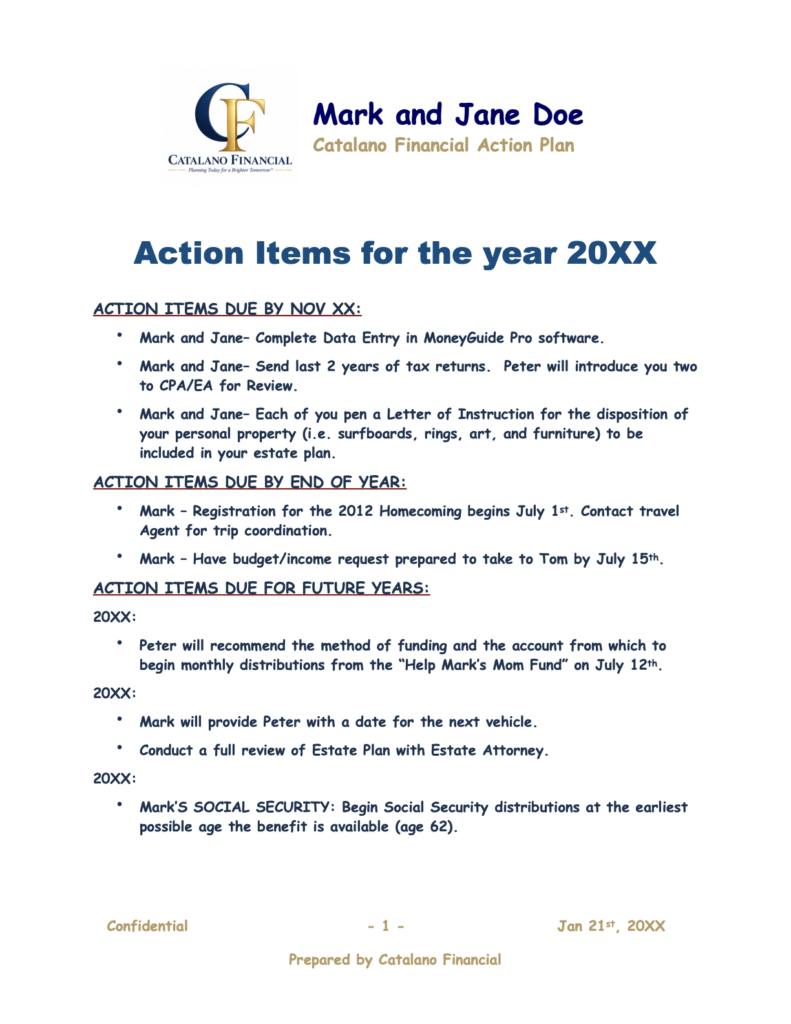
The Catalano Financial Action Plan: Turning Advice Into Action
One of the most important lessons I’ve learned during my career is that identifying a financial recommendation and getting it implemented are two very different things.
That’s why I use a written Catalano Financial Action Plan to help organize recommendations and establish clear next steps.
The Action Plan identifies what needs to be accomplished, who is responsible, and the intended timeframe.
For example, a client’s Action Plan might include updating estate planning documents with an attorney, reviewing life insurance coverage, adjusting retirement savings, or gathering information needed for a tax-related decision.
Some actions belong to the client. Others may involve Catalano Financial or an outside professional.
The purpose is to make responsibilities visible and help prevent important recommendations from being overlooked.
During our structured progress meetings, we can review completed actions, address outstanding items, and establish new priorities as circumstances change.
A financial plan provides direction. The Catalano Financial Action Plan helps turn that direction into meaningful steps.
In my experience, clients appreciate having a clear understanding of what happens next—not simply receiving another report or set of recommendations.
Coordinating Your Financial Professionals
Successful individuals and business owners often work with several financial and legal professionals.
A CPA or EA may focus on taxes. An attorney may handle estate documents or business matters. An insurance specialist may evaluate protection needs. An investment manager may oversee financial assets.
Each professional brings specialized knowledge.
The challenge is recognizing when their recommendations affect one another.
Consider a business owner preparing to sell a company.
The transaction may involve business valuation, tax planning, investment management, retirement income, estate planning, and insurance considerations.
No single professional should be expected to provide every specialized service.
But an ongoing financial advisor can help the client identify overlapping decisions and coordinate discussions with the appropriate professionals.
At Catalano Financial, I view that coordination as an important part of serving as a trusted advisor.
The goal is not to replace the client’s other professionals. It is to help ensure important financial decisions are considered within the broader context of the client’s objectives.
What More Than Three Decades of Experience Has Taught Me
I began working in financial services in 1992.
Over the years, I’ve seen how easily a good financial recommendation can lose momentum when there isn’t a clear process for implementing it.
A client may fully understand why an action matters, yet months pass before the necessary documents are gathered, an appointment is scheduled, or another professional completes their part.
I’ve also seen how valuable it can be when clients know what the next step is and who is responsible.
That experience influenced my emphasis on written action plans, structured meetings, and coordination with other professionals.
For me, the purpose of an ongoing advisory relationship is not to create more meetings.
It’s to create greater clarity, accountability, and continuity in the client’s financial life.
The most important part of a financial plan isn’t the binder or the software. It’s what happens after the recommendations are made.
Who Benefits Most From Ongoing Financial Oversight?
An ongoing advisory relationship may be particularly useful for:
Business owners whose personal finances are closely connected to their companies, compensation, succession plans, or potential business sales.
Corporate executives managing retirement benefits, concentrated investments, deferred compensation, and retirement transitions.
Retirees and pre-retirees who need to coordinate investment withdrawals, income sources, taxes, and changing spending needs.
Families with complex financial circumstances involving multiple accounts, properties, insurance arrangements, or estate planning objectives.
Financial delegators who prefer to have an experienced advisor help manage the ongoing financial planning process rather than coordinate everything themselves.
The common thread isn’t simply wealth.
It’s the need for ongoing guidance, organization, and professional coordination.
Is an Ongoing Advisory Relationship Necessary for Everyone?
No.
Some people need a comprehensive financial plan and are comfortable implementing the recommendations themselves.
Others primarily want professional investment management.
Strategic Wealth Partnership is intended for clients who want a broader, ongoing relationship that addresses multiple areas of their financial lives.
At Catalano Financial, the initial comprehensive financial plan is separately priced, and the ongoing partnership is established under its own agreed scope and compensation arrangement.
The important thing is choosing the level of service that matches your needs.
Financial Guidance Should Be a Process, Not Just an Event
Financial circumstances rarely remain unchanged for long.
A meaningful advisory relationship should provide a way to revisit priorities, respond to new information, and help clients make decisions as life unfolds.
That’s the purpose behind the three-meeting process, the GPS, and the broader Strategic Wealth Partnership approach.
It’s not about the money—it’s the emotion behind the money.
The financial decisions we make ultimately affect the people, responsibilities, and experiences that matter most to us.
What Does This Level of Financial Guidance Cost?
Understanding the services is important. Understanding how the advisor is compensated is equally important.
Read next: How Much Does an Ongoing Wealth Advisory Relationship Cost?
Explore our planning fees, investment management arrangements, and Strategic Wealth Partnership pricing.
At Catalano Financial, my goal is to help clients approach those decisions with greater clarity and an organized process for moving forward.
Catalano Financial is an independent registered investment adviser based in The Woodlands, Texas. The services provided depend on the applicable client agreement. Investment results are not guaranteed. Tax and legal services are provided by appropriately qualified professionals.