

You may be able to reduce taxes on retirement withdrawals by carefully choosing which accounts to draw from, managing how much taxable income you recognize each year, considering Roth conversions, planning ahead for required minimum distributions, and coordinating investment decisions with your tax professional.
The best approach depends on your retirement income needs, the accounts you own, your tax situation, and what you want your money to accomplish. There is no single withdrawal strategy that works for everyone.
At Catalano Financial in The Woodlands, Texas, we help individuals, families, and business owners evaluate these decisions as part of a broader retirement income plan. Many of the people we serve have spent decades accumulating retirement savings. When retirement approaches, they discover that deciding how to use those savings can be every bit as important as building them.
After working in financial services since 1992, I’ve seen tax laws change, markets rise and fall, and retirement planning strategies evolve. One thing hasn’t changed: people want confidence that the financial decisions they’re making today will help support the life they want to live tomorrow.
That’s why I believe the conversation about retirement withdrawals should begin with your goals, not simply with a tax bracket.
Why Does the Order of Retirement Withdrawals Matter?
The order in which you withdraw money from retirement and investment accounts can influence how much income tax you pay, how your remaining investments are positioned, and how much flexibility you retain in future years.
Consider someone who enters retirement with a traditional IRA, a Roth IRA, a taxable investment account, and Social Security benefits. Each source has different tax characteristics.
Withdrawals from a traditional IRA are generally taxable as ordinary income to the extent they represent pretax contributions and earnings. Qualified Roth IRA withdrawals generally are tax-free. Selling investments in a taxable account may generate capital gains or losses, but the entire amount withdrawn isn’t necessarily taxable.
A common rule of thumb is to spend taxable investments first, then traditional retirement accounts, and Roth accounts last. That may be appropriate in some circumstances, but I wouldn’t treat it as a universal rule.
Sometimes it makes sense to take a measured distribution from a traditional IRA during a relatively low-income year. Other times, using Roth funds may help avoid pushing additional income into a higher tax bracket. A taxable account may provide flexibility, particularly when investments have a relatively high cost basis.
The important point is that you have choices. Understanding those choices before making withdrawals can help you avoid decisions driven solely by an immediate need for cash.
Can I Reduce Taxes by Managing My Tax Bracket?
Yes. One strategy is to evaluate how much additional taxable income you can recognize before moving into a higher marginal federal income tax bracket.
The federal income tax system is progressive. Different portions of taxable income are taxed at different rates, so moving into a higher bracket does not cause all your income to be taxed at that higher rate.
For 2026, the 22% federal marginal income tax bracket for married couples filing jointly begins above $100,800 of taxable income, and the 24% bracket begins above $211,400. These figures are based on taxable income, not total retirement account withdrawals or gross household income.
Source: IRS — 2026 Tax Inflation Adjustments.
Knowing where you stand within the tax brackets can help when considering additional IRA withdrawals or Roth conversions.
But brackets are only part of the picture. Social Security taxation, capital gains, Medicare premiums, deductions, and other income-related rules can affect the actual cost of recognizing additional income.
A strategy that looks attractive when considering only federal income tax brackets may become less attractive when those other consequences are included.
Should I Withdraw From My Traditional IRA Before Required Minimum Distributions Begin?
In some circumstances, yes.
Traditional IRAs and many employer-sponsored retirement accounts are subject to required minimum distributions, commonly called RMDs. Under current law, the starting age depends on your birth year. It is generally age 73 for people born from 1951 through 1959 and age 75 for people born in 1960 or later.
The amount generally depends on the prior year-end account balance and an applicable IRS life-expectancy factor.
If you’ve accumulated substantial pretax retirement savings, those mandatory withdrawals may increase your taxable income later in retirement—even when you don’t need the entire distribution for living expenses.
That creates a question worth considering several years before RMDs begin.
Would it be beneficial to withdraw some money from a traditional IRA earlier, potentially during years when your income is lower?
The answer depends on your current tax rate, future income expectations, investment needs, and other planning considerations. Early withdrawals can also have tax consequences, and distributions before age 59½ may trigger an additional tax unless an exception applies.
We shouldn’t assume that postponing every taxable distribution for as long as possible will always produce the best outcome.
For details, see the IRS Required Minimum Distribution FAQs.
Can Roth Conversions Help Reduce Taxes in Retirement?
A Roth conversion involves moving eligible funds from a traditional retirement account into a Roth account. The converted amount generally creates taxable income to the extent it consists of previously untaxed money.
Why would someone voluntarily pay taxes today?
Because qualified Roth withdrawals generally are tax-free, and Roth IRAs are not subject to lifetime RMDs for their original owners.
That can provide flexibility later in retirement.
Imagine retiring at age 62, before beginning Social Security and before RMDs become mandatory. Depending on your other income sources, those years might provide an opportunity to evaluate converting some traditional IRA funds to a Roth IRA.
However, a Roth conversion isn’t automatically beneficial. The immediate tax cost matters, as does the amount of time the converted funds may remain invested, the source of money used to pay the taxes, and the effect on other tax provisions.
Conversions can also influence Medicare premiums when income exceeds applicable thresholds.
The decision should be evaluated using reasonable assumptions and, where appropriate, coordinated with your CPA or other qualified tax professional.
The goal isn’t to convert the largest possible amount. It’s to determine whether a conversion supports your broader financial plan.
How Does Social Security Affect Retirement Withdrawal Taxes?
Social Security benefits may become partially taxable depending on your combined income.
Under federal rules, up to 85% of Social Security benefits may be included in taxable income. That doesn’t mean the benefits are taxed at an 85% rate; it means a portion of the benefits may be subject to your applicable tax rates.
Withdrawals from traditional retirement accounts can affect this calculation, along with pensions, investment income, and other financial resources.
That makes the timing of Social Security benefits an important part of retirement income planning.
For example, delaying Social Security while taking carefully planned IRA withdrawals might be worth evaluating for some retirees. For others, health considerations, family circumstances, income needs, or the value of beginning benefits earlier may point toward a different approach.
I wouldn’t make the Social Security decision based on income taxes alone. Your retirement income strategy should consider the financial and personal consequences together.
Learn more from IRS Publication 915 — Social Security and Equivalent Railroad Retirement Benefits.
Can Retirement Withdrawals Increase My Medicare Premiums?
Yes, and this is one of the consequences retirees sometimes overlook.
Medicare uses income-related monthly adjustment amounts, known as IRMAA, to determine whether certain beneficiaries pay higher premiums for Medicare Part B and Part D.
These adjustments are generally based on modified adjusted gross income from a tax return approximately two years earlier.
A substantial traditional IRA withdrawal, Roth conversion, or realized investment gain could increase your reported income enough to affect future Medicare premiums.
For example, someone making a Roth conversion at age 63 may need to consider how that income could influence Medicare premiums when they become eligible at age 65.
That doesn’t mean the conversion is a bad idea. It means the additional premium cost belongs in the analysis.
The same principle applies to capital gains, retirement distributions, and other decisions that may change your reported income.
Good financial planning looks beyond the immediate transaction.
Can Tax-Loss Harvesting Help Offset Investment Gains?
Potentially, when you own investments in taxable accounts.
Tax-loss harvesting involves selling an investment that has declined in value to realize a capital loss. Subject to applicable rules, that loss may offset capital gains and, within limits, a portion of ordinary income. Unused eligible losses may generally be carried forward.
At Catalano Financial, we use evidence-based investment principles that emphasize diversification, asset allocation, and long-term discipline.
Our Betterment platform offers automated tax-loss harvesting for eligible taxable investment accounts when the feature is enabled. This can help identify certain opportunities that might otherwise be missed.
However, tax-loss harvesting isn’t available for every account or situation, and it doesn’t guarantee tax savings. Wash-sale rules, investments held outside the platform, future capital gains, and individual tax circumstances can affect the outcome.
Tax-loss harvesting also shouldn’t become a reason to abandon an appropriate investment strategy.
Investment decisions should continue to reflect your goals, time horizon, and ability and willingness to accept risk.
Can Charitable Giving Reduce Taxes on IRA Withdrawals?
For charitably inclined retirees, a qualified charitable distribution, or QCD, may be worth considering.
Generally, an eligible IRA owner who is at least age 70½ can direct a qualifying distribution from an IRA to an eligible charity. If the requirements are met, the distribution may be excluded from taxable income.
A QCD may also satisfy all or part of an applicable IRA required minimum distribution.
This can be particularly useful for someone who already intends to support charitable organizations and wants to evaluate how that giving fits within their retirement income strategy.
But the rules matter. Not every account, distribution, or charitable organization qualifies, and the applicable annual limits and documentation requirements must be followed.
Charitable giving should begin with your values and intentions. Any potential tax benefit is a consideration, not the sole reason to give.
For further information, see IRS Publication 590-B.
What About the New Tax Deduction for Seniors?
Current federal law provides an additional deduction for certain taxpayers age 65 and older for tax years 2025 through 2028.
Eligible individuals may qualify for a deduction of up to $6,000, or up to $12,000 for married couples filing jointly when both spouses qualify. The deduction begins phasing out when modified adjusted gross income exceeds $75,000 for an individual or $150,000 for joint filers.
This deduction is separate from the existing additional standard deduction available to eligible older taxpayers, and it can be available whether the taxpayer itemizes or takes the standard deduction.
It does not mean Social Security benefits are universally tax-free.
For retirees, the provision is another reason to coordinate retirement distributions with annual tax planning rather than assuming the same withdrawal strategy should be used every year.
See IRS — Working Families Tax Cuts: Individuals and Workers.
A Practical Example: Two Ways to Fund the Same Retirement Spending
Imagine a married couple who needs an additional $60,000 for retirement spending beyond their other income.
They have a traditional IRA, a Roth IRA, and a taxable brokerage account.
One approach would be to withdraw the entire $60,000 from the traditional IRA. Assuming all of that money is pretax, the withdrawal would generally add $60,000 to ordinary income.
Another approach might involve withdrawing $30,000 from the traditional IRA, $20,000 from a taxable brokerage account, and $10,000 from a Roth IRA.
Under the second approach, the IRA portion would generally add $30,000 to ordinary income. The taxable brokerage withdrawal would produce taxable income only to the extent of realized gains or other taxable amounts, and the Roth withdrawal might be tax-free if it meets the applicable requirements.
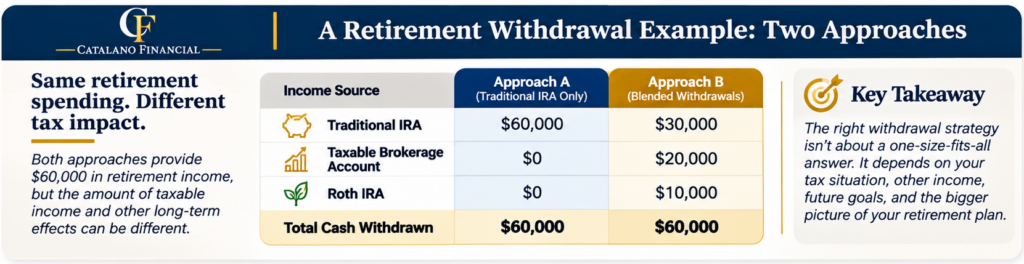
| Source | Approach A | Approach B |
|---|---|---|
| Traditional IRA | $60,000 | $30,000 |
| Taxable brokerage account | $0 | $20,000 |
| Roth IRA | $0 | $10,000 |
| Total cash withdrawn | $60,000 | $60,000 |
Both approaches provide the same $60,000 in cash before accounting for any taxes due. But the composition of the withdrawals may produce different current-year tax consequences.
Does that automatically make Approach B better?
No.
Using Roth assets today leaves fewer Roth assets available later. Selling taxable investments may create capital gains. Taking less from a traditional IRA could leave larger required distributions in the future.
The better decision depends on the couple’s complete financial circumstances.
This is precisely why retirement income planning should involve more than a withdrawal calculator.
Illustrative example only. Assumes traditional IRA distributions are fully taxable and Roth IRA distributions are qualified. Brokerage tax consequences depend on cost basis and other factors. Neither approach represents an individualized recommendation or guarantees a lower lifetime tax burden.
Why Does Experience Matter When Planning Retirement Withdrawals?
When I entered financial services in 1992, retirement planning looked different in many ways. Tax laws were different, investment technology was different, and the tools available to financial advisors were far less sophisticated than those we have today.
Since then, I’ve seen clients navigate changing markets, interest-rate environments, tax legislation, family circumstances, and retirement expectations.
The tools have improved. We can analyze more scenarios, automate investment processes, and evaluate decisions with greater detail.
But experience has taught me that having more information doesn’t automatically make a financial decision easier.
People still want to know whether they’re making the right choices for themselves and their families. They want to understand the consequences, especially when a decision may be difficult to reverse.
That’s where I believe the relationship with a financial advisor matters.
A retirement withdrawal strategy isn’t simply a calculation of which account produces the lowest tax bill this year. It’s a series of decisions that may affect your lifestyle, financial security, family, and legacy for decades.
I believe those decisions deserve careful analysis, an experienced perspective, and an ongoing conversation.
Why Should My Financial Advisor and CPA Work Together?
Your CPA or other qualified tax professional can evaluate tax-law requirements, deductions, reporting obligations, and the specific tax consequences of proposed transactions.
Your financial advisor can help evaluate how those transactions affect retirement income, investment allocation, cash flow, financial risk, and long-term goals.
Consider a proposed Roth conversion. Your CPA may help determine the tax cost, while your financial advisor evaluates the conversion within your retirement income projections, investment strategy, and anticipated future distributions.
Neither perspective should be ignored.
At Catalano Financial, we help coordinate with clients’ tax professionals, attorneys, and other appropriate specialists when decisions involve multiple areas of their financial lives.
That coordination is an important part of comprehensive financial planning, particularly for people whose financial circumstances have become more complex.
How Does the Financial Road Map Help Guide These Decisions?
Before deciding how to reduce retirement taxes, I want to understand what you’re trying to accomplish with your money.
That’s the purpose of our Financial Road Map®.
It’s a guided discovery experience that helps us understand your values, the people who matter most to you, and the goals you want your financial resources to support.
Perhaps your priority is maintaining your lifestyle without worrying about every market fluctuation. Perhaps it’s helping your children, spending more time traveling, supporting your church or favorite charities, or ensuring your spouse will be financially secure.
Those are the reasons behind the numbers.
The Financial Road Map is not a tax analysis or a completed financial plan. It provides the personal context that helps guide the detailed planning, implementation, and ongoing advice that follow.
We start with your values, connect them to your goals, and then determine how your money can best support them.
Values → Goals → Money.
Frequently Asked Questions About Reducing Retirement Withdrawal Taxes
Is it better to withdraw from a 401(k) or Roth IRA first?
Neither is automatically better. Traditional 401(k) withdrawals generally create ordinary taxable income, while qualified Roth IRA withdrawals generally do not. The appropriate choice depends on your current and expected future taxes, spending needs, and broader financial strategy.
Can I avoid taxes on traditional IRA withdrawals?
Most traditional IRA withdrawals attributable to pretax money are taxable. However, eligible qualified charitable distributions, after-tax IRA basis, and other specific rules can affect the taxable amount. There is no universal strategy that makes all traditional IRA withdrawals tax-free.
Should I convert my entire IRA to a Roth IRA?
Not necessarily. Converting a large traditional IRA balance may generate substantial current-year taxes and affect other income-related costs. Partial conversions over multiple years may be worth evaluating, but the appropriate strategy depends on individual circumstances.
Do I have to take money from my IRA when I turn 73?
The RMD starting age depends on your birth year and account type. Under current law, it is generally 73 for people born from 1951 through 1959 and 75 for people born in 1960 or later. Certain employer-plan exceptions may apply.
Can my financial advisor help coordinate retirement withdrawals with my CPA?
Yes. A financial advisor can help evaluate withdrawal timing, investment allocation, retirement cash flow, and other planning considerations while coordinating with your CPA or qualified tax professional on tax-specific questions.
The Goal Is a Better Retirement, Not Simply a Smaller Tax Bill
Taxes are an important part of retirement income planning, but they shouldn’t dictate every decision.
A strategy that saves taxes today may create other costs tomorrow. A Roth conversion that increases this year’s tax bill may or may not provide benefits in future years. A decision to delay withdrawals might preserve assets today while reducing flexibility later.
We cannot predict future tax laws, market returns, or every circumstance retirement will bring.
What we can do is understand the decisions within our control, evaluate the trade-offs, and develop a financial strategy that can adapt as life changes.
At Catalano Financial, our work begins with what matters most to you. We then help connect your values and goals to retirement income planning, investment management, financial coordination, and ongoing advice.
If you’re approaching retirement or already retired and wondering whether your withdrawal strategy could be more tax-efficient, we’d welcome the opportunity to learn about your circumstances.
Control What You Can. Plan for What You Can’t.
Peter Catalano, ChFC®, CLU®
Catalano Financial | The Woodlands, Texas
Important information: This article is educational and does not constitute individualized investment, tax, or legal advice. Retirement distributions, Roth conversions, charitable distributions, and other strategies involve eligibility requirements and tax consequences that vary by individual. Consult qualified tax and legal professionals before implementing tax-sensitive strategies. Investments involve risk, including possible loss of principal. Tax information reflects rules available as of November 2026.