
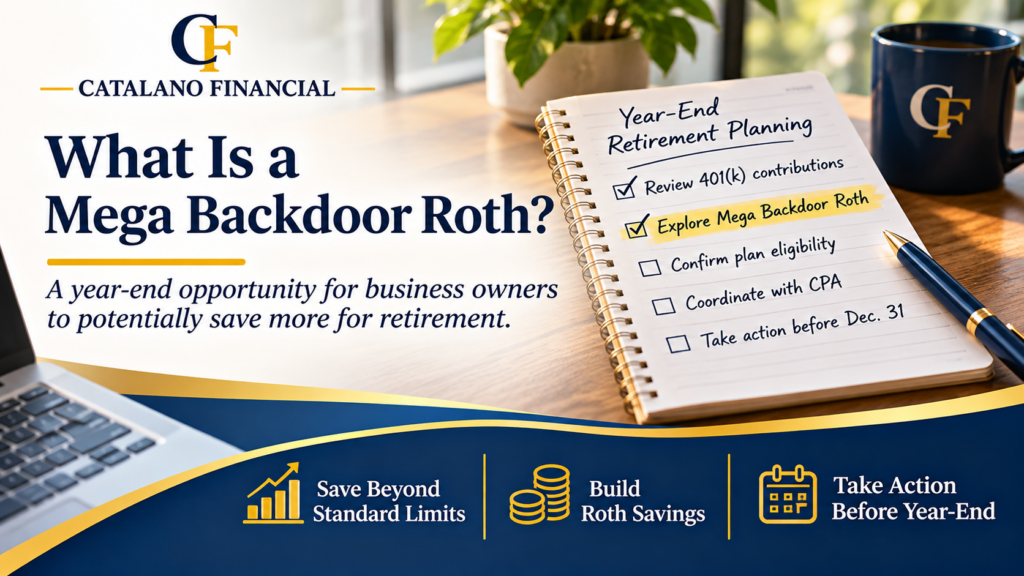
A mega backdoor Roth is a retirement savings strategy that allows eligible individuals to contribute additional after-tax dollars to a 401(k) and then convert those contributions into Roth retirement savings.
For 2026, the regular employee 401(k) contribution limit is $24,500, but the combined employee and employer annual additions limit can reach $72,000, excluding eligible catch-up contributions. That difference may create a substantial opportunity for business owners and higher-income professionals who have already made their regular retirement contributions and still have money they would like to put toward their future.
With December 31 approaching, there’s another reason to pay attention. Betterment recently introduced a mega backdoor Roth feature for eligible Solo 401(k) accounts, making a strategy that has historically involved considerable administrative work easier to implement.
I’ve worked in financial services since 1992, and I’ve learned that some of the most valuable planning opportunities aren’t necessarily found in a new investment or a prediction about where the market is headed. Sometimes they’re found by understanding the rules, looking carefully at how your financial accounts are structured, and making thoughtful decisions while an opportunity is still available.
For self-employed professionals and business owners, this is one of those strategies worth understanding before the year comes to a close.
How Does a Mega Backdoor Roth Work?
The name sounds complicated, but the basic concept is easier to understand when you separate it into two steps.
First, you make a voluntary after-tax contribution to a 401(k) plan that specifically allows this type of contribution. This is different from making a regular pretax contribution or a designated Roth 401(k) employee contribution. You’ve already paid income tax on the money, so you don’t receive an additional deduction for contributing it.
The second step is converting that after-tax balance into Roth money, either through an eligible in-plan Roth conversion or another permitted rollover arrangement. Once the money has been converted, it can potentially grow with the benefit of tax-free qualified distributions in retirement.
It’s important to understand that simply contributing after-tax dollars doesn’t complete the strategy. The conversion is a separate transaction, and any untaxed earnings included in that conversion may create taxable income.
Betterment explains this process in its Mega Backdoor Roth Guide, which walks through the contribution and conversion steps available on its Solo 401(k) platform.
I like to think of the strategy as creating another potential destination for retirement savings. But before deciding whether to use it, we need to understand how much contribution room is available and whether moving additional money into a retirement account makes sense for your financial life.
How Much Could You Contribute to a Mega Backdoor Roth in 2026?
The first number most people recognize is the regular employee 401(k) contribution limit, which is $24,500 for 2026. For those age 50 and older, the IRS generally permits an additional $8,000 catch-up contribution, with a higher $11,250 catch-up amount available to eligible individuals ages 60 through 63.
What many business owners don’t realize is that the regular employee contribution limit isn’t necessarily the maximum amount that can be contributed to a 401(k) for the year.
For 2026, the combined annual additions limit is generally $72,000, or 100% of eligible compensation if less. That limit includes regular employee contributions, employer contributions, and voluntary after-tax contributions. Eligible catch-up contributions are generally permitted above that amount.
The IRS 401(k) Contribution Limits explains how these limits work together.
Consider a hypothetical self-employed business owner who has sufficient eligible compensation and a Solo 401(k) that permits after-tax contributions and Roth conversions.
| Type of contribution | 2026 example |
|---|---|
| Regular employee contribution | $24,500 |
| Employer contribution | $20,000 |
| Additional voluntary after-tax contribution | $27,500 |
| Total contributions | $72,000 |
In this example, the owner has contributed $44,500 through the regular employee and employer portions of the plan, leaving $27,500 of potential room for voluntary after-tax contributions.
If the plan permits it, that additional $27,500 could subsequently be converted to Roth.
The important distinction is that this isn’t an additional $27,500 income tax deduction. It’s an opportunity to place more money into a retirement account with potential tax-free qualified withdrawals in the future.
Actual contribution capacity depends on compensation, business structure, contributions to other plans, and the provisions of the retirement plan. The illustration shows how the strategy can work, not what every business owner is entitled to contribute.
Which Business Owners May Benefit From a Mega Backdoor Roth?
I think this strategy is particularly worth discussing with business owners who have strong cash flow, are already contributing substantially to retirement accounts, and want to evaluate additional long-term savings opportunities.
A consultant operating through an LLC, an independent contractor with consistent income, or a professional who has transitioned from full-time employment into self-employment may find that a Solo 401(k) provides more flexibility than the retirement arrangement they’ve used in the past.
For some owners, the business may have grown considerably while their retirement savings strategy has remained unchanged. They might still be using a SEP IRA or another arrangement established years earlier, without having revisited whether it continues to fit their needs.
That doesn’t mean everyone should replace an existing plan. It means the retirement arrangement deserves periodic review, especially when income, business structure, and long-term goals change.
A Solo 401(k) generally serves a self-employed owner with no employees who must be covered other than an eligible spouse. Business owners with other employees face additional plan requirements and may need a different type of retirement arrangement.
Employees at larger companies may also qualify for a mega backdoor Roth if their employer’s plan permits voluntary after-tax contributions and eligible Roth conversions. However, not every plan offers those features, even when it allows regular Roth 401(k) contributions.
For business owners, this is one reason I encourage looking at retirement planning as part of a broader financial strategy rather than treating it as an annual contribution decision.
Coordinated Financial Planning for Business Owners explains how retirement planning, business decisions, and personal wealth can be evaluated together.
What’s the Difference Between a Backdoor Roth and a Mega Backdoor Roth?
The two strategies have similar names, but they’re not the same thing.
A traditional backdoor Roth generally involves making a nondeductible contribution to a traditional IRA and then converting that amount to a Roth IRA. It’s frequently considered by higher-income individuals who cannot contribute directly to a Roth IRA because of income restrictions.
A mega backdoor Roth uses a 401(k) plan instead. It involves voluntary after-tax contributions that are separate from regular employee deferrals, followed by an eligible Roth conversion.
The contribution limits and tax rules differ, and an individual’s existing retirement accounts may influence how the strategies are evaluated.
For example, the traditional IRA aggregation rules can affect the taxable portion of an IRA Roth conversion. An in-plan Roth conversion of voluntary after-tax 401(k) contributions operates under different rules, although the taxable treatment of any earnings and the plan’s provisions still matter.
Neither strategy should be selected simply because someone has heard that Roth accounts are beneficial. The decision depends on your present tax situation, potential future income needs, available cash, and the role those assets will play in retirement.
If you’re interested in how retirement distributions can affect taxable income later in life, see Retirement Income Planning.
What Has Changed With Betterment’s New Mega Backdoor Roth Feature?
One reason I’m writing about this now is that Betterment introduced a new mega backdoor Roth capability for eligible Solo 401(k) accounts in October 2026.
Historically, implementing this strategy could involve separate paperwork, manual tracking of contribution categories, coordination with plan administrators, and additional steps to move after-tax money into Roth accounts.
Betterment has made the process more manageable by allowing eligible Solo 401(k) participants and their advisors to make after-tax contributions digitally, track the different contribution categories, and initiate in-plan Roth conversions through its platform.
Its system also provides information about the amount of a conversion attributable to earnings, helping investors and advisors recognize the potential taxable portion before completing the transaction.
Betterment discusses these developments in A Simpler Way to Offer a Mega Backdoor Roth.
As of November 2026, the conversion is not automatic. The after-tax contribution must be received and become eligible for conversion, and a separate conversion must then be initiated. Betterment’s current feature is available for eligible Solo 401(k) plans, while similar functionality for its standard employer 401(k) plans is expected in 2027.
At Catalano Financial, Betterment is one of the investment platforms we use to help implement and manage client portfolios. I appreciate technology that can make financial strategies easier to administer, but I also believe it’s important to distinguish between having access to a feature and determining whether that feature is appropriate.
Technology can simplify the transaction. It doesn’t replace the planning conversation.
Why Does the Timing of a Roth Conversion Matter?
When you contribute after-tax money to an eligible 401(k), that money may be invested before the Roth conversion takes place. If the investments appreciate during that period, the accumulated earnings generally have not yet been taxed.
When those earnings are included in a Roth conversion, they may create taxable income, even though the original after-tax contribution generally isn’t taxed a second time.
For that reason, investors often consider converting after-tax contributions soon after they’re eligible, rather than allowing substantial untaxed earnings to accumulate before completing the conversion.
There’s another important consideration: an in-plan Roth conversion generally cannot be reversed. If you later decide the transaction wasn’t appropriate, you typically cannot simply undo it.
Betterment addresses these issues in its Mega Backdoor Roth Disclosure.
This is where I believe working with both your financial advisor and CPA can be especially valuable. We want to understand the potential benefits before taking action, but we also need to evaluate the tax consequences, timing, and other financial priorities that could influence the decision.
Can You Still Take Advantage of a Mega Backdoor Roth Before December 31, 2026?
For some business owners, yes. But with the calendar already in November, I wouldn’t recommend waiting until the last few days of December to begin the conversation.
There are several moving parts that can affect whether a contribution or conversion is possible for 2026, including the type of business, the terms of the retirement plan, employee contribution elections, available compensation, and the time required to establish or transfer an account.
It’s also important to distinguish between making a contribution for a particular tax year and completing a Roth conversion during that calendar year. Some employer contributions may be made after December 31 under applicable rules, while employee contribution elections and other transactions can have different requirements. A Roth conversion completed in 2027 generally belongs to the 2027 tax year, even if the underlying contribution was designated for 2026.
Betterment has indicated that transferring an existing Solo 401(k) from another provider may take several weeks, although eligible new contributions may be possible while the transfer is being processed.
That’s why I believe the right time to review the opportunity is now.
If you’re a business owner who has had a particularly strong year, already made substantial retirement contributions, or simply hasn’t reviewed your retirement plan recently, it may be worth determining whether additional contribution capacity exists.
Even if a mega backdoor Roth turns out not to be the right strategy, the conversation may reveal other planning opportunities that deserve attention before year-end.
Is a Mega Backdoor Roth Always the Best Financial Decision?
No, and this is where I think it’s important to look beyond the contribution limits.
A business owner may have the ability to contribute additional money to a retirement account but also need liquidity for business operations, taxes, debt reduction, or a future investment. Someone approaching retirement may need to consider how additional Roth savings fit with traditional retirement accounts, taxable investments, Social Security, and anticipated withdrawals.
The tax advantages of a Roth account can be valuable, but they don’t eliminate investment risk, account restrictions, or the need to maintain financial flexibility.
I’ve always believed that financial decisions should be evaluated in the context of the life someone wants to live. A strategy that looks attractive on a spreadsheet isn’t necessarily the right choice if it creates financial pressure elsewhere.
That’s why I don’t begin a financial planning relationship by asking how much money we can put into a particular account. I want to understand what you’re trying to accomplish and how your financial resources can help you get there.
Why Should Your Financial Advisor and CPA Work Together on This Strategy?
A mega backdoor Roth is a good example of how retirement planning, tax planning, and business decisions overlap.
Your CPA can help evaluate compensation, contribution eligibility, tax reporting, and the consequences of converting after-tax contributions and earnings. Your financial advisor can help determine how the strategy fits into your broader retirement plan, investment allocation, cash flow, and other financial priorities.
For self-employed business owners, the legal and tax structure of the business can also influence how employer contributions are calculated and whether the plan is appropriate.
At Catalano Financial, I believe these professionals should be working toward the same goals rather than addressing separate pieces of your financial life without considering how they connect.
How Financial Advisors, CPAs, and Attorneys Collaborate discusses why coordination matters when financial decisions affect multiple areas of your life.
What Has More Than 30 Years in Financial Services Taught Me About Opportunities Like This?
When I began working in financial services in 1992, Roth IRAs didn’t exist. The investment technology we use today was far less developed, and the retirement planning opportunities available to individuals and business owners looked different from what we have now.
Over the years, I’ve watched Congress change retirement legislation, introduce new account provisions, adjust contribution limits, and create planning opportunities that weren’t available to previous generations.
Some of those changes have been meaningful. Others have added complexity. What hasn’t changed is the importance of making decisions based on the individual rather than the product or strategy being discussed.
I’ve worked in financial services since 1992, and one thing I’ve learned is that there’s always going to be another investment idea, another tax strategy, or another change in the rules. The real value of financial planning is understanding which opportunities actually make sense for your life. Before we talk about how much money you can put into a Roth account, I want to understand what you’re trying to accomplish with that money in the first place.
— Peter Catalano, ChFC®, CLU®, Catalano Financial
That’s the philosophy behind the way we approach financial planning.
We begin with the Financial Road Map®, a guided discovery experience designed to understand your values, the people who matter most to you, and the goals you want your money to support.
The Financial Road Map isn’t a completed financial analysis or a recommendation to purchase an investment. It’s the starting point that helps us understand why the financial decisions matter.
From there, we can evaluate retirement strategies, coordinate with your other professionals, and consider appropriate implementation.
Values → Goals → Money.
Frequently Asked Questions About Mega Backdoor Roth Contributions
Is a mega backdoor Roth legal in 2026?
Yes. The strategy uses permitted voluntary after-tax contributions and eligible Roth conversions within qualified retirement plans. Whether you can use it depends on the provisions of your specific 401(k) plan and applicable IRS requirements.
Can I contribute $72,000 to a Roth 401(k) in 2026?
The $72,000 figure represents the general combined annual additions limit for 2026, excluding eligible catch-up contributions. It doesn’t mean everyone can make $72,000 in regular Roth employee deferrals. Depending on compensation, other contributions, and plan provisions, a mega backdoor Roth may allow additional after-tax contributions to be converted to Roth within the applicable limits.
Does a mega backdoor Roth reduce my current income taxes?
Generally, voluntary after-tax contributions don’t provide a current income tax deduction. The potential benefit is the opportunity for future qualified Roth distributions to be tax-free. Any untaxed earnings included in a conversion may be taxable.
Can I use a mega backdoor Roth if I already have a traditional IRA?
Potentially. An in-plan Roth conversion of after-tax 401(k) contributions is subject to different rules from a traditional IRA backdoor Roth conversion. Existing IRA balances do not automatically prevent use of the 401(k) strategy, although your full financial and tax situation should still be reviewed.
Can my spouse participate in my Solo 401(k)?
An eligible spouse who legitimately works in the business and meets applicable compensation and plan requirements may participate. Betterment supports eligible spouse participation in its Solo 401(k) offering.
Does Betterment automatically convert after-tax contributions into Roth?
Not as of November 2026. Betterment’s current Solo 401(k) process requires the after-tax contribution to be completed first, followed by a separate in-plan Roth conversion. Investors and advisors should follow the platform’s current procedures.
Is November too late to start planning for a 2026 mega backdoor Roth?
Not necessarily. Some eligible investors may still have time to establish or review their retirement plan and complete appropriate transactions, but deadlines vary. It’s important to review plan requirements and processing times rather than assuming all contributions and conversions can wait until the tax-filing deadline.
Before 2026 Ends, Let’s Find Out Whether You’re Missing a Retirement Planning Opportunity
If you’re self-employed, own a profitable business, or have already maximized your regular 401(k) contributions, you may have additional retirement planning options worth exploring.
A mega backdoor Roth isn’t appropriate for everyone, and I wouldn’t suggest implementing one simply because the contribution limits are attractive. But if you’ve had a successful year and want to understand whether additional Roth savings fit into your financial plan, this is a good time to have that conversation.
At Catalano Financial, I work with individuals and business owners to connect retirement planning, investments, tax-aware strategies, and long-term financial goals. We can review your existing retirement accounts, discuss potential opportunities, and coordinate with your CPA before you make a decision.
With the end of the year approaching, I’d encourage you not to put off the conversation until December 30. We may discover an opportunity worth pursuing, or we may determine that another approach better supports your goals. Either way, you’ll have a clearer understanding of your options.
Let’s Review Your Year-End Retirement Planning Opportunities
You don’t need to have all the answers before we meet. That’s why we start with a conversation.
Control What You Can. Plan for What You Can’t.
Peter Catalano, ChFC®, CLU®
Catalano Financial | The Woodlands, Texas
This article is provided for general educational purposes and does not constitute individualized investment, tax, or legal advice. Contribution limits, plan eligibility, deadlines, and tax treatment depend on individual circumstances and applicable law. Roth conversions are generally irreversible and may create taxable income. Qualified Roth distributions are subject to applicable requirements. Consult qualified tax and legal professionals before implementing tax-sensitive strategies. Investments involve risk, including possible loss of principal. Betterment is a separate service provider; applicable advisory, platform, and investment expenses may apply.