
Not everyone needs the same type of financial advisor relationship.
Some people need a comprehensive financial plan to understand where they stand and what decisions they should consider. Others are comfortable managing most of their financial affairs but want professional oversight of their investment portfolio.
And then there are individuals, families, and business owners who would rather have an experienced advisor helping coordinate their broader financial lives.
At Catalano Financial, I believe understanding these differences is one of the most important steps in choosing the right financial relationship.
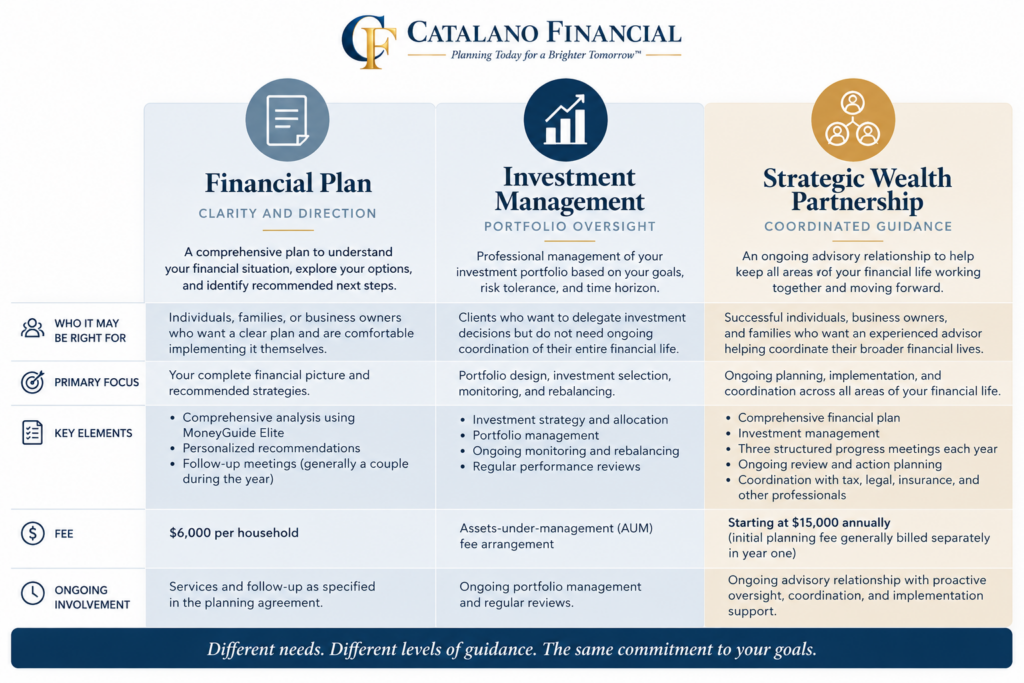
Option 1: Comprehensive Financial Planning
A comprehensive financial plan is designed to help answer some of life’s most important financial questions.
Can I afford to retire? Am I saving enough? How should I think about Social Security? Do I have appropriate insurance coverage? What happens financially if I sell my business?
Using MoneyGuide Elite, I work with clients to evaluate their financial circumstances, identify goals, consider planning alternatives, and develop recommendations.
A comprehensive plan may address retirement income, investments, cash flow, debt, insurance needs, estate planning considerations, and other relevant areas.
At Catalano Financial, a comprehensive financial plan is offered for $6,000 per household.
The engagement includes the planning work and follow-up meetings specified in the client agreement, generally a couple of meetings during the year to review progress and discuss implementation.
For someone who enjoys managing their own finances and is comfortable carrying out recommendations, this may be exactly what they need.
A comprehensive financial plan provides guidance and direction. It does not automatically include ongoing coordination of every financial decision or management of the client’s entire financial life.
Additional services, including investment management or insurance solutions, may be available under separate arrangements.
Option 2: Professional Investment Management
Investment management focuses on how financial assets are invested and monitored.
Depending on the engagement, services may include developing an investment allocation, selecting investments, managing portfolio risk, rebalancing, and reviewing performance in relation to the client’s objectives.
At Catalano Financial, investment management is available through an assets-under-management (AUM) fee arrangement.
Professional investment management may be appropriate for someone who wants to delegate portfolio decisions but does not need a comprehensive, ongoing relationship covering every aspect of their financial life.
For example, a client may already have a CPA, an estate planning attorney, and a clear retirement strategy. They may simply want an experienced professional managing their investments.
That’s a legitimate need, and it doesn’t necessarily require a Strategic Wealth Partnership.
However, managing investments is not the same as coordinating an entire financial life.
Option 3: Strategic Wealth Partnership
Strategic Wealth Partnership is designed for people who want a deeper, ongoing advisory relationship.
This may include successful business owners, corporate executives approaching retirement, retirees with complex financial circumstances, or families with substantial assets and multiple financial considerations.
These clients are often what I call financial delegators.
They value having a trusted advisor who understands their goals and helps coordinate the various financial decisions and professionals involved in their lives.
Strategic Wealth Partnership at Catalano Financial is built around several important components:
- A comprehensive financial plan that establishes the foundation for the relationship.
- Investment management under the agreed compensation arrangement.
- Three structured progress meetings each year.
- Ongoing review of financial priorities and implementation needs.
- A written action plan to help identify responsibilities and next steps.
- Coordination with tax, legal, estate, insurance, and other subject matter experts when appropriate.
The relationship extends beyond preparing recommendations or managing an investment portfolio.
It creates a process for examining the broader financial picture and helping clients make progress over time.
Why I Believe the Distinction Matters
I began my career in financial services in 1992.
Over the years, I’ve prepared financial plans, managed investments, reviewed insurance needs, worked with other professionals, and helped clients make decisions affecting their financial futures.
One lesson I’ve learned is that the amount of ongoing attention a client needs can vary dramatically, even among people with similar levels of wealth.
Some clients need a clear plan and are perfectly capable of executing it themselves.
Others want someone to help manage the process, recognize when decisions intersect, and coordinate with the appropriate professionals.
Neither approach is inherently better.
The important thing is matching the advisory relationship to the client’s actual needs.
I also believe in being clear about what an engagement includes.
A client who hires me for a comprehensive financial plan should receive the planning services we’ve agreed upon. A client who enters a Strategic Wealth Partnership is choosing a more extensive ongoing relationship with a different level of service and responsibility.
That distinction helps establish clear expectations for everyone.
Some people need a financial plan. Others want someone to help them carry it out and keep the different parts of their financial lives working together. Those are two very different relationships.
An Example: Two Business Owners With Different Needs
Consider two business owners in The Woodlands, each approaching retirement.
The first has a well-established CPA, an attorney who handles business matters, and a straightforward investment portfolio. This owner primarily wants to understand whether selling the business will provide enough financial independence.
A comprehensive financial plan may be sufficient to evaluate the retirement possibilities and identify important decisions.
The second owner faces a more complicated situation.
A business sale may create significant investable assets, tax considerations, retirement income decisions, estate planning questions, and insurance needs. The owner wants someone to help coordinate the different moving parts and remain involved as decisions unfold.
That owner may benefit from a Strategic Wealth Partnership.
The difference isn’t simply the amount of money involved.
It’s the complexity of the decisions and how much responsibility the client wants to delegate.
What Does Each Service Cost?
Catalano Financial offers several ways to begin or maintain a financial advisory relationship.
Financial Roadmap® — $500. An initial planning experience focused on values, goals, and understanding the financial circumstances that matter most. The fee is credited toward applicable engagement fees when the client hires Catalano Financial.
Comprehensive Financial Plan — $6,000. A separately priced financial planning engagement using MoneyGuide Elite, including the services and follow-up specified in the planning agreement.
Investment Management — AUM-based fees. Fees are determined by the investment advisory agreement and the assets managed.
Strategic Wealth Partnership — Starting at $15,000 annually. An ongoing advisory relationship with a broader scope of planning, coordination, and oversight. The initial comprehensive financial planning fee is generally charged separately during the first year.
Depending on the engagement, investment management compensation may be structured through an AUM arrangement or an agreed fixed-fee relationship. The applicable agreements explain the services and compensation.
In subsequent years, planning needs and fees are evaluated based on the work required and the agreed scope of the renewed relationship.
Insurance and annuity solutions may also be available when appropriate, with applicable compensation disclosed.
Which Relationship Is Right for You?
Here are three questions worth asking yourself:
1. Do I primarily need answers, or do I want ongoing help making decisions?
A comprehensive financial plan may provide the answers and direction you need.
2. Am I comfortable coordinating my financial professionals and following through on recommendations?
If so, planning and investment management may be sufficient.
3. Would I prefer to delegate more of the ongoing financial oversight to a trusted advisor?
If your financial life involves multiple professionals, significant decisions, or changing circumstances, a Strategic Wealth Partnership may be worth exploring.
At Catalano Financial, my goal isn’t to convince every client to purchase the most extensive service.
It’s to help people understand what they need and choose an advisory relationship that makes sense for their circumstances.
It’s not about the money—it’s the emotion behind the money.
Financial advice should ultimately support the people, goals, and experiences that give money its purpose.
What Does an Ongoing Advisory Relationship Actually Look Like?
If you’re considering a Strategic Wealth Partnership, the next question is what your advisor does throughout the year.
Read next: What Does an Ongoing Financial Advisor Actually Do Throughout the Year?
Learn about our three structured progress meetings, Catalano Financial Action Plan, and coordination with other professionals.
Catalano Financial is an independent registered investment adviser based in The Woodlands, Texas. Services, fees, and responsibilities are governed by the applicable client agreements. Investment results are not guaranteed. Insurance and annuity products may involve separate compensation. Tax and legal advice is provided by appropriately qualified professionals.