

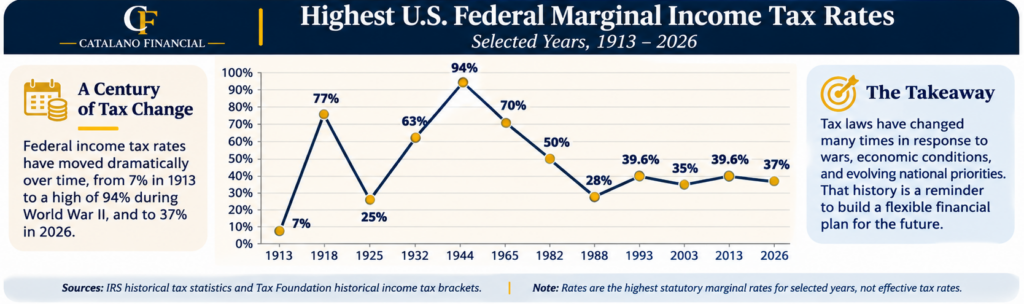
Federal income taxes in the United States have changed enormously since 1913, when the modern income tax began with a top marginal rate of just 7%. That rate climbed to 94% during World War II, declined substantially during the tax reforms of the 1980s, and stands at 37% in 2026. Over those 113 years, Congress has repeatedly changed not only tax rates but also deductions, exemptions, retirement savings incentives, and the way different types of income are taxed. For anyone saving for retirement, managing investments, or planning to transfer wealth, the history of U.S. income taxes offers an important lesson: the tax rules we live with today are not necessarily the rules we’ll live with tomorrow.
I’ve worked in financial services since 1992, and one of the benefits of spending more than three decades in this profession is having the opportunity to see how financial decisions play out through different economic and legislative environments. I’ve watched tax laws change, retirement planning strategies evolve, investment markets experience remarkable growth and painful declines, and families adjust their expectations as circumstances changed around them.
Those experiences have shaped how I approach financial planning at Catalano Financial in The Woodlands, Texas. I believe history is worth studying, not because it tells us exactly what will happen next, but because it reminds us how important it is to prepare for a future we cannot predict.
How Did Federal Income Taxes Begin in 1913?
The story of the modern American income tax begins with the 16th Amendment, ratified in February 1913. The amendment gave Congress the authority to tax income without apportioning that tax among the states according to population, establishing the constitutional foundation for the income tax system we recognize today.
Income taxation wasn’t an entirely new idea. The federal government had imposed income taxes during the Civil War, but those measures were temporary. For much of the nation’s earlier history, federal revenue came primarily from tariffs on imported goods and excise taxes on selected products. The federal government was also much smaller, with responsibilities and expenditures that looked very different from those of the modern United States.
When Congress introduced the modern income tax in 1913, relatively few Americans were required to pay it. The highest marginal rate was 7%, applying only to taxable income above a substantial threshold for that era. Most households were outside the system altogether.
It would have been difficult for Americans living in 1913 to imagine how central the federal income tax would eventually become to household finances, business decisions, retirement savings, and national policy.
Yet within a few years, the country would enter World War I, and the income tax system would begin changing dramatically.
Historical source: National Archives — The 16th Amendment.
How Have Federal Income Tax Rates Changed Over the Past Century?
One of the most interesting ways to understand American tax history is to follow the highest marginal federal income tax rate through different periods.
During World War I, the highest rate increased sharply as the government sought additional revenue. After the war, rates declined, only to rise again during the Great Depression and World War II. In 1944, the highest marginal rate reached 94%, a figure that still surprises people when they first encounter it.
The postwar decades brought further changes. The top rate remained extraordinarily high by today’s standards for many years, before falling to 70% in 1965. Tax reforms during the 1980s eventually reduced the headline highest statutory bracket to 28%, although the system included a 33% marginal-rate phaseout range for certain taxpayers.
Since the early 1990s, the highest statutory rate has generally moved between 35% and 39.6%, with the current highest federal individual income tax rate standing at 37% for 2026.
Historical Federal Income Tax Rates: Selected Years
| Year | Top marginal rate | Historical context |
|---|---|---|
| 1913 | 7% | Modern income tax begins |
| 1918 | 77% | World War I |
| 1925 | 25% | Postwar tax reductions |
| 1932 | 63% | Great Depression |
| 1944 | 94% | World War II |
| 1965 | 70% | Tax reductions of the 1960s |
| 1982 | 50% | Early-1980s reforms |
| 1988 | 28%* | Tax Reform Act of 1986 |
| 1993 | 39.6% | Higher top statutory rate |
| 2003 | 35% | Early-2000s legislation |
| 2013 | 39.6% | Changes following 2012 legislation |
| 2026 | 37% | Current highest statutory rate |
The 1988 tax structure included a 33% marginal-rate phaseout range for certain taxpayers. These are selected historical statutory rates, not effective tax rates paid by households.
Sources: IRS historical tax statistics and Tax Foundation historical income tax brackets.
What I find especially interesting about this history is how dramatically the rules have changed within a single lifetime. Someone who began working in the 1950s experienced a very different income tax environment from someone entering the workforce in the 1980s. And someone who retired in 2000 has lived through several additional rounds of tax legislation since leaving the workforce.
This is one reason I hesitate whenever I hear someone confidently predict what income taxes will look like 20 years from now. We can certainly study economic conditions and proposed legislation, but history gives us very little reason to believe any particular tax structure is permanent.
Did Americans Really Pay 94% of Their Income in Taxes?
When people hear that the highest federal income tax rate reached 94% in 1944, they sometimes assume wealthy Americans were handing over 94 cents of every dollar they earned. That’s not how a progressive income tax system works.
The 94% figure was a marginal rate, meaning it applied to taxable income within the highest bracket, above a specified threshold. Income below that threshold was subject to lower rates, and the calculation of taxable income depended on the deductions and rules in effect at the time.
The distinction between marginal and effective tax rates is just as important today. Someone whose highest marginal bracket is 24% does not automatically pay 24% of their entire income in federal income taxes. Their income passes through different brackets, and deductions, credits, and the tax treatment of particular income sources can affect the final liability.
It’s also important to remember that historical tax systems were structured differently. A comparison of the highest rates in 1944, 1988, and 2026 doesn’t tell us everything about the tax burden people actually experienced in those years.
For that reason, I believe tax history is most useful when we look beyond the headline numbers and consider how the rules influence financial behavior and decisions.
Why Did Income Taxes Rise During Wars and Economic Crises?
Throughout American history, major national events have influenced federal tax policy. World War I and World War II required enormous government expenditures, leading Congress to increase tax rates and expand the number of Americans subject to income taxation.
The Great Depression also brought significant changes as policymakers confronted economic instability, declining revenue, and growing pressure on federal finances.
By World War II, income taxes had become relevant to a much broader portion of the population. Federal withholding helped make the system part of ordinary working life, and the income tax became an established source of government revenue.
Later decades brought different priorities. Some policymakers argued for lower marginal rates to encourage investment and economic activity, while others emphasized federal revenue needs and the distribution of tax burdens. Tax legislation reflected those competing priorities, as well as changing economic conditions.
Whether one agrees with a particular tax policy is a separate question from understanding its history. From a financial planning perspective, what matters is recognizing that tax laws respond to circumstances beyond any individual’s control.
Families still have to make decisions about saving, investing, retirement, and spending while those debates unfold.
What Changed During the Tax Reforms of the 1980s?
The 1980s are especially interesting to me because they provide important context for the financial environment I entered when I began my career in 1992.
The Economic Recovery Tax Act of 1981 reduced individual income tax rates, and the Tax Reform Act of 1986 brought a substantial restructuring of the federal income tax system. The latter legislation lowered the headline highest statutory rate while changing deductions and other provisions intended to broaden the tax base.
These reforms illustrated something that remains true today: tax legislation is rarely as simple as raising or lowering one percentage. A change in marginal rates may be accompanied by adjustments to deductions, exemptions, credits, and the treatment of specific transactions.
By the time I entered financial services, advisors were working within a system that had already changed considerably from the one their predecessors had known. The highest statutory rate increased again in 1993, and the decades that followed brought further changes affecting retirement accounts, investment income, and estate planning.
Looking back, I’m reminded that financial advice has always required more than familiarity with the rules in effect at a particular moment. It requires an understanding of how those rules interact with the decisions people make throughout their lives.
How Have Income Taxes Changed Since I Entered Financial Services in 1992?
When I started in financial services in 1992, the Roth IRA didn’t exist. The retirement account options and tax-planning strategies available to individuals and families were different from those we have today, and the technology used to analyze financial decisions was far more limited.
The Roth IRA was established through legislation enacted in 1997, giving Americans another way to structure retirement savings. During the following decades, Congress repeatedly changed individual income tax rates, retirement contribution limits, estate tax provisions, and the rules governing distributions from retirement accounts.
The Tax Cuts and Jobs Act of 2017 introduced another significant round of changes, including lower individual income tax rates and a substantially larger standard deduction. Legislation enacted in 2025 subsequently made the individual rate structure permanent under current law and introduced additional changes affecting deductions and other provisions.
Meanwhile, retirement legislation such as the SECURE Act and SECURE 2.0 changed required minimum distribution ages and other retirement account rules.
These developments have practical consequences. A person retiring with substantial traditional IRA assets may face different decisions about withdrawals than someone who has accumulated a combination of traditional, Roth, and taxable investments. A business owner preparing to sell a company may need to consider how capital gains and other taxes affect the proceeds available to support retirement. Families planning to transfer wealth may discover that estate planning strategies need to be reviewed as exemptions and other rules change.
I’ve seen enough changes during my career to know that financial planning cannot be a one-time event. The assumptions we make today need to be revisited as laws, markets, and personal circumstances evolve.
Could Tariffs Replace Federal Income Taxes?
Because tariffs were such an important source of federal revenue before the modern income tax, the idea of replacing income taxes with tariffs occasionally returns to public discussion.
It’s an interesting historical comparison, but the American economy and federal government have changed substantially since the early 1900s.
Tariffs are taxes imposed on imported goods. Although they’re collected from importers, their economic costs may be shared among businesses, consumers, and foreign producers depending on the circumstances. They can influence prices, supply chains, trade relationships, and business decisions.
Federal income taxes, by contrast, are based on taxable income and are part of a much broader revenue system that also includes payroll taxes, corporate taxes, and other sources.
Replacing a substantial portion of federal income tax revenue with tariffs would require significant policy changes, and the economic consequences would depend on how those changes were structured.
I wouldn’t encourage someone to make retirement decisions based on the assumption that federal income taxes are going away. That’s not because future reform is impossible, but because a sound financial plan should not depend on one uncertain political outcome.
We can evaluate possible changes without pretending to know which proposals will become law.
What Does the History of Income Taxes Mean for Retirement Planning Today?
For someone approaching retirement, the most important lesson from this history is that today’s tax rules are only one part of a financial plan that may need to support you for 20 or 30 years—or longer.
Consider a couple who have accumulated most of their retirement savings in traditional IRAs and 401(k)s. Those accounts may have provided valuable tax advantages while they were working, but withdrawals of pretax funds generally become taxable income in retirement.
If the couple also has Roth assets, taxable investments, a pension, or Social Security benefits, they may have additional choices about how and when to recognize taxable income.
Those choices matter because retirement income sources don’t all receive the same tax treatment. Traditional IRA distributions can affect ordinary taxable income, qualified Roth withdrawals generally do not, and selling investments in taxable accounts may create capital gains or losses.
The timing of these decisions can also influence the taxation of Social Security benefits and, for some retirees, Medicare premiums.
No one can guarantee that a particular strategy will minimize taxes over an entire retirement. Future tax rates, investment results, spending needs, and personal circumstances all introduce uncertainty.
What we can do is evaluate the alternatives, understand the trade-offs, and look for opportunities to preserve flexibility.
This is why I believe retirement income planning should involve more than selecting a withdrawal rate and hoping the investments perform as expected.
Why Does Experience Matter When Financial Rules Keep Changing?
One of the things I’ve come to appreciate over more than three decades in financial services is that people don’t experience financial decisions as abstract calculations. They experience them through their families, businesses, responsibilities, hopes, and concerns about the future.
A change in tax law might appear to be a technical adjustment on paper, but for a retiree it could influence when to withdraw money from an IRA, whether to make a Roth conversion, or how to provide for a surviving spouse. For a business owner, it may affect the timing of a sale or the resources available after leaving the business.
The calculations matter, of course. We need accurate information, sound analysis, and a clear understanding of the risks involved. But the numbers are only useful when they’re connected to the person making the decisions.
I’ve been in financial services since 1992, and if there’s one thing those years have taught me, it’s that the rules will change. Tax laws change, markets change, and life certainly changes. What matters is having a plan built around what you value, understanding the decisions you can control, and having someone you trust to help you adjust when circumstances change. That’s what I believe financial planning should be about.
— Peter Catalano, ChFC®, CLU®, Catalano Financial
That’s the perspective I bring to financial planning. Experience doesn’t allow me to predict future tax legislation or investment returns, but it does reinforce the importance of disciplined decisions, thoughtful preparation, and an ongoing advisory relationship.
I don’t believe the value of a financial advisor should be measured only by investment performance. People also need guidance when circumstances are uncertain, when difficult decisions arise, and when the financial choices available to them have consequences that extend far beyond an account statement.
How Can Financial Planning Help When Future Tax Rates Are Uncertain?
A thoughtful financial plan doesn’t require us to know exactly what Congress will do next. Instead, it helps us understand how different outcomes might affect your financial resources and which decisions may be worth considering today.
For example, we might evaluate the balance between traditional and Roth retirement accounts, review potential withdrawal strategies, consider how investment gains could affect taxable income, or discuss charitable and estate planning objectives with qualified professionals.
Some strategies may be appropriate under current tax law, while others may become more or less attractive as circumstances change. The important thing is to evaluate them within the context of your overall financial life rather than treating each decision as an isolated transaction.
At Catalano Financial, we also recognize the importance of coordinating with CPAs, attorneys, and other qualified professionals. Tax preparation, tax advice, estate documents, investment management, and retirement income planning involve different areas of expertise, but the decisions often overlap.
When those professionals communicate effectively, clients have a better opportunity to understand how one decision may affect another.
How Does the Financial Road Map Help Prepare for an Uncertain Future?
Before we discuss tax strategies, investment allocations, or retirement income projections, I want to understand what you’re working toward.
Our Financial Road Map® is a guided discovery experience that helps identify your values, the people who matter most to you, and the goals you want your financial resources to support. It’s not a tax analysis or a completed financial plan. It’s the foundation for understanding why the financial decisions matter in the first place.
For one family, that may mean maintaining a comfortable retirement while helping children and grandchildren. For another, it may mean preparing to sell a business and having the freedom to pursue a different chapter of life. Someone else may be focused on charitable giving, travel, or simply having greater confidence about the years ahead.
Once we understand those priorities, we can begin the detailed financial analysis, consider appropriate strategies, and coordinate implementation and ongoing reviews.
That’s the philosophy behind our approach to Values-Based Financial Planning: Values → Goals → Money.
The tax code will continue to evolve, but your values provide an important reference point when deciding how to respond.
Frequently Asked Questions About U.S. Income Tax History
When did the United States begin collecting federal income taxes?
The federal government introduced income taxes during the Civil War, but those measures were later repealed. The modern federal income tax began in 1913 following ratification of the 16th Amendment, which established the constitutional authority for the current system.
What was the highest federal income tax rate in American history?
The highest top marginal federal individual income tax rate was 94% in 1944 and 1945. That rate applied to taxable income above the highest threshold rather than to a taxpayer’s entire income, so it should not be confused with the effective rate paid.
How much were federal income taxes in 1913?
The first modern federal income tax had a top marginal rate of 7%, and exemptions meant that most Americans did not owe federal individual income tax under the new system.
What is the highest federal income tax rate in 2026?
The highest statutory federal individual income tax rate for 2026 is 37%. The amount of income subject to that rate depends on filing status and the applicable tax brackets.
Will federal income taxes increase in the future?
No one can predict future legislation with certainty. Congress can change tax rates, deductions, credits, and other provisions, but the timing and details of any future changes depend on the legislative process.
Should I change my retirement strategy because tax laws might change?
Potential future tax changes are worth considering, but they shouldn’t be the only reason to make a major financial decision. Retirement planning should evaluate current tax rules, possible future scenarios, investment risks, income needs, and personal goals together.
Control What You Can. Plan for What You Can’t.
Looking back over more than a century of American income tax history, I find it remarkable how much has changed. The country moved from a system in which relatively few households paid federal income tax to one in which tax decisions influence nearly every stage of financial life.
The rules have changed through wars, recessions, economic expansions, and major legislative reforms. And there’s every reason to expect that financial planning will continue to require adaptation, even though we cannot know what future laws will look like.
For me, that reinforces why financial planning should begin with the life you want to live rather than with a prediction about tax rates or investment returns.
We cannot control what Congress will do, how markets will perform, or every circumstance that may affect our families. We can, however, make informed decisions about saving, investing, retirement income, risk, and the way we use our financial resources.
At Catalano Financial, our goal is to help clients make those decisions thoughtfully, coordinate the appropriate professionals, and maintain a financial strategy that can evolve as life changes.
Because ultimately, it’s not simply about how much money you accumulate or how much tax you avoid. It’s about what that money makes possible for you and the people you care about.
Control What You Can. Plan for What You Can’t.
Peter Catalano, ChFC®, CLU®
Catalano Financial | The Woodlands, Texas
This article is provided for general educational purposes and does not constitute individualized investment, tax, or legal advice. Historical tax rates are presented for context and should not be interpreted as effective tax rates paid by individual taxpayers. Tax rules and individual circumstances vary. Consult qualified tax and legal professionals before implementing tax-sensitive strategies. Historical experience does not predict future tax policy or investment results. Information reflects sources available as of November 2026.