

Income taxes affect how much of your retirement savings you can actually spend, which accounts you should consider withdrawing from, and how long your financial resources may need to last.
Withdrawals from traditional IRAs and 401(k)s, Social Security benefits, pensions, investment accounts, and annuities can all receive different tax treatment. Coordinating these income sources can help you make more informed decisions about taxes, retirement spending, and long-term financial flexibility.
At Catalano Financial in The Woodlands, Texas, we help individuals, families, and business owners understand how taxes fit into their broader retirement income strategy. We particularly work with people who have accumulated approximately $1 million to $5 million in investable assets and want experienced guidance in coordinating their financial decisions.
For many people approaching retirement, the question changes from How much have I saved? to How much of what I’ve saved can I comfortably spend?
Those are two very different questions.
Why Taxes Become More Complicated in Retirement
During your working years, much of your income may come from an employer, with income taxes withheld automatically from your paycheck. You contribute to retirement accounts, accumulate investments, and gradually build the financial resources you hope will support you later in life.
Retirement changes that relationship.
Instead of receiving a regular paycheck, you may begin drawing income from several different sources. Each can affect your tax return differently, and the timing of those withdrawals may influence how much you ultimately pay.
A withdrawal from a traditional IRA generally increases ordinary taxable income. A qualified Roth IRA withdrawal generally does not. Selling an investment in a taxable brokerage account may create a capital gain or loss, while Social Security benefits may become partially taxable depending on your other income.
Even Medicare premiums can be affected by income reported on your tax return.
This is why retirement income planning involves more than choosing investments or calculating a withdrawal rate. It requires understanding how the different parts of your financial life work together.
How Are Different Retirement Income Sources Taxed?
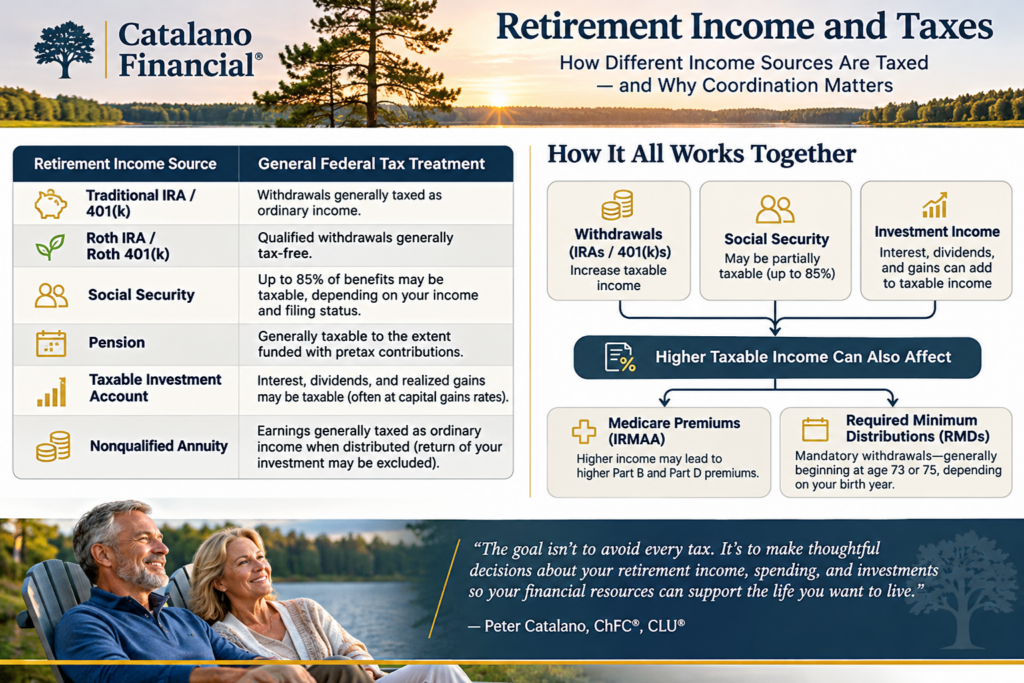
Not every dollar you receive during retirement is treated the same way.
| Income source | General federal income tax treatment |
|---|---|
| Traditional IRA | Withdrawals generally taxed as ordinary income, except amounts attributable to after-tax basis |
| Traditional 401(k) | Pretax withdrawals generally taxed as ordinary income |
| Roth IRA | Qualified distributions generally free from federal income tax |
| Roth 401(k) | Qualified distributions generally free from federal income tax |
| Social Security | Up to 85% of benefits may be included in taxable income |
| Pension | Generally taxable to the extent benefits come from pretax contributions |
| Taxable brokerage account | Interest, dividends, and realized gains may be taxable; return of investment principal generally is not |
| Nonqualified annuity | Earnings are generally taxable as ordinary income when distributed; return of after-tax investment may be excluded |
These differences create planning opportunities, but they also create potential complications. A decision that appears reasonable when looking at one account may produce an unexpected result when combined with other retirement income.
The objective is not necessarily to pay the least tax in any single year. It is to evaluate how today’s decisions may affect your financial resources over the years ahead.
How Can Traditional IRAs and 401(k)s Affect Retirement Taxes?
Traditional retirement accounts often provide tax benefits during the years you’re saving. Contributions may reduce current taxable income, and investment earnings generally accumulate without annual income taxation inside the account.
The trade-off comes when money is withdrawn.
Distributions attributable to pretax contributions and earnings are generally included in ordinary income. Depending on your circumstances, a large withdrawal could move additional income into a higher marginal tax bracket, increase the taxable portion of Social Security benefits, or affect Medicare premiums.
Consider someone retiring with a substantial traditional IRA, a company pension, and Social Security benefits. Each source may provide valuable retirement income, but the combined tax consequences can be different from those of someone with the same total assets distributed among traditional, Roth, and taxable accounts.
Neither arrangement automatically produces a better retirement outcome. What matters is how the resources are coordinated with spending needs, tax considerations, and long-term goals.
What About Required Minimum Distributions?
Traditional IRAs and many employer retirement plans are subject to required minimum distributions, commonly called RMDs. Under current law, the starting age generally depends on the owner’s birth year: age 73 for certain cohorts and age 75 for people born in 1960 or later.
These mandatory distributions can become an important consideration for people who have accumulated substantial pretax retirement savings.
You may not need the full distribution to support your lifestyle, but the taxable amount generally must still be included in your income. This can affect other financial decisions, including charitable giving, investment withdrawals, and tax planning.
Planning before RMDs begin may provide more flexibility than waiting until distributions become mandatory.
Will I Pay Income Taxes on Social Security Benefits?
Possibly. Social Security retirement benefits may be partially taxable depending on your filing status and combined income.
The IRS generally evaluates your adjusted gross income, certain tax-exempt interest, and one-half of your Social Security benefits to determine how much of those benefits may be taxable.
Depending on the calculation, up to 85% of your benefits can be included in taxable income. This does not mean Social Security is taxed at an 85% tax rate. It means that as much as 85% of the benefit amount may be subject to your applicable income tax rates.
This distinction matters because decisions involving IRA withdrawals, investment gains, employment income, and other financial resources may influence the taxation of your Social Security benefits.
The decision about when to begin Social Security should therefore be evaluated alongside your other retirement income sources, rather than treated as an isolated choice.
Can Roth Accounts Help Manage Retirement Taxes?
Roth accounts can provide an additional source of flexibility because qualified withdrawals generally are not subject to federal income tax.
For someone who has accumulated most of their retirement savings in traditional accounts, a Roth IRA may offer another way to fund spending needs without necessarily increasing taxable income.
However, converting money from a traditional IRA to a Roth IRA generally creates taxable income in the year of conversion to the extent the converted amount was pretax.
A Roth conversion may make sense in some circumstances, particularly when current and anticipated future tax rates, available cash to pay conversion taxes, investment horizons, and estate planning considerations support the decision. In other circumstances, the immediate tax cost may outweigh the potential benefit.
The important question is not simply whether Roth accounts are better than traditional accounts.
It is whether the combination of accounts you own provides the flexibility needed to support your retirement goals.
How Do Taxes Affect Investment Withdrawals?
Taxable investment accounts operate differently from traditional retirement accounts.
When you sell an investment, federal income tax generally applies to the realized gain rather than the entire amount received. The gain or loss depends on the investment’s adjusted cost basis and sale proceeds.
Long-term capital gains may qualify for preferential federal tax rates, while short-term gains are generally taxed at ordinary income rates. Dividends and interest may also have different tax treatment.
Investment losses can sometimes offset realized capital gains and, within applicable limits, other taxable income.
At Catalano Financial, investment management is an important part of the broader planning relationship. We use evidence-based portfolio principles, including diversification, disciplined asset allocation, and an understanding of the relationship between investment risk and expected returns.
For eligible taxable accounts, our Betterment platform also offers automated tax-loss harvesting when the feature is enabled. This technology can help identify certain opportunities to realize investment losses, although actual tax benefits depend on individual circumstances, wash-sale rules, and other considerations.
Technology can help implement a tax-aware investment strategy. It cannot determine what retirement means to you, how much you should spend, or which financial decisions best support your personal priorities.
Those questions require a broader conversation.
Can Retirement Income Affect My Medicare Premiums?
Yes. Medicare uses income-related monthly adjustment amounts, commonly called IRMAA, to determine whether certain beneficiaries pay additional premiums for Medicare Part B and Part D.
These adjustments are generally based on modified adjusted gross income from a tax return approximately two years earlier.
For example, a large Roth conversion or substantial realized investment gain may increase reported income and potentially affect future Medicare premiums.
This doesn’t automatically mean you should avoid realizing gains or making Roth conversions. It means the potential Medicare impact should be evaluated alongside the other financial consequences.
An appropriate strategy considers the overall benefit of a decision, rather than concentrating on one tax bracket or premium threshold.
A Retirement Income Example: Same Savings, Different Decisions
Imagine two retired households, each with $2 million in total investments. Both want to support a comfortable retirement, maintain financial flexibility, and provide for their families.
The first household has accumulated most of its savings in traditional retirement accounts. The second has a combination of traditional retirement accounts, Roth assets, and taxable investments.
Although both households have the same total investment value, their after-tax spending flexibility may differ.
The first household may rely more heavily on distributions that increase ordinary taxable income. The second may have additional choices about which accounts to draw from in a particular year.
But account location alone doesn’t determine which household is better positioned. Cost basis, future tax rates, spending requirements, investment returns, account balances, and many other factors affect the outcome.
The lesson is that the amount you’ve saved matters, but how your financial resources are structured and used matters too.
Illustrative example only. It does not represent actual clients, investment performance, or a guarantee of tax savings.
What Has More Than Three Decades in Financial Services Taught Me About Taxes?
I’ve worked in financial services since 1992, through changing tax laws, investment markets, interest-rate environments, and economic conditions.
Over those years, financial planning strategies have evolved. Tax brackets change, estate tax exemptions change, retirement account rules change, and new financial products become available.
Yet one of the most important lessons remains consistent: we cannot predict or control what future legislation or investment markets will bring.
What we can do is understand the rules that apply today, evaluate the decisions within our control, and build financial strategies that can be reviewed and adjusted as circumstances change.
For someone approaching retirement, those controllable decisions may include how much to spend, how much to save before retiring, when to begin withdrawals, how investments are allocated, and how much investment risk is appropriate.
We cannot choose the return a portfolio will deliver. We can make informed decisions about the risks we take in pursuing our financial goals.
Why Should My Financial Advisor Coordinate With My Tax Professional?
Tax planning and financial planning are closely connected, but they are not the same service.
Your CPA or other qualified tax professional plays an essential role in evaluating tax law, preparing returns, and providing tax advice. Your financial advisor helps evaluate how investment, retirement, insurance, and other financial decisions fit within your broader financial circumstances.
For example, a proposed Roth conversion may involve questions about current taxable income, future retirement distributions, Medicare premiums, estate objectives, and the investments held within the account.
Rather than addressing each issue separately, we believe these decisions should be considered together.
At Catalano Financial, we help clients coordinate with their accountants, attorneys, and other appropriate professionals when decisions extend beyond investment management.
This coordination is particularly valuable when financial circumstances become more complex, whether through retirement, business ownership, inheritance, or significant changes in family responsibilities.
How Does the Financial Road Map Fit Into Retirement Tax Planning?
Before evaluating withdrawal strategies, tax-efficient investments, or retirement income projections, we want to understand what your financial resources are intended to accomplish.
Our Financial Road Map® is a guided conversation about your personal values, the people who matter most to you, and the goals you want your money to support.
Perhaps retirement means spending more time with your grandchildren, traveling with your spouse, supporting a charitable organization, or simply having the freedom to enjoy your life without constantly worrying about money.
Those priorities should help guide the financial decisions that follow.
The Financial Road Map is the beginning of that discovery process. Detailed retirement income analysis, tax-aware planning recommendations, implementation, and ongoing review follow as appropriate to the advisory relationship.
We believe the purpose of financial planning is not simply to accumulate the largest possible account balance or minimize every dollar of taxes.
It is to help you use your financial resources to support a meaningful life.
What Can You Control About Taxes in Retirement?
You cannot control future federal tax legislation, investment returns, inflation, or interest rates. History provides useful perspective, but it cannot tell us with certainty what will happen next.
You can make decisions about spending, saving, account withdrawals, investment allocation, risk exposure, and the timing of certain financial transactions. You can also work with qualified professionals to understand the potential consequences before making significant decisions.
Not every tax can be avoided, and not every tax-saving strategy is appropriate.
The objective is to develop a retirement income strategy that supports your goals, recognizes uncertainty, and allows for adjustments as your circumstances change.
Control what you can. Plan for what you can’t.
Frequently Asked Questions About Retirement Income Taxes
Do I have to pay income taxes on my 401(k) after retirement?
Withdrawals from a traditional 401(k) are generally subject to ordinary income tax to the extent the money represents pretax contributions and earnings. Qualified withdrawals from a Roth 401(k) generally are not subject to federal income tax.
Is Social Security income taxable in Texas?
Texas does not impose an individual state income tax, but federal income taxes may still apply to Social Security benefits depending on your combined income and filing status.
Should I withdraw from my IRA or brokerage account first?
There is no universal answer. The appropriate withdrawal sequence depends on your tax situation, investment holdings, cost basis, required distributions, spending needs, and long-term financial goals.
Can a financial advisor help me reduce taxes during retirement?
A financial advisor can help evaluate tax-aware retirement strategies, including withdrawal sequencing, investment allocation, Roth conversions, and coordination with a qualified tax professional. No advisor can guarantee lower taxes or eliminate the effects of future tax-law changes.
How much of my retirement savings will I actually be able to spend?
That depends on your spending needs, investment resources, other income sources, taxes, inflation, investment performance, and retirement time horizon. A comprehensive financial planning analysis can help evaluate possible outcomes and trade-offs.
Retirement Is About More Than Taxes
Taxes deserve attention because they affect how much of your financial resources remains available to support your life. But minimizing taxes should never become the sole purpose of your retirement plan.
At Catalano Financial, we begin by understanding what matters most to you, then help develop financial strategies around those priorities. Our approach combines retirement income planning, investment management, financial coordination, and an ongoing personal relationship when appropriate.
I’ve never believed that a financial advisor’s value should be measured only by a rate of return.
Markets will rise and fall. Tax laws will change. Life will bring unexpected challenges and opportunities.
Our role is to help you navigate those decisions thoughtfully, remain focused on what matters, and make informed choices through the good times and the difficult ones.
It’s not about the money—it’s the emotion behind the money.
If you’re approaching retirement or already retired and wondering how taxes may affect your income, we welcome the opportunity to learn about your circumstances and discuss whether Catalano Financial may be a good fit.
Explore our Financial Road Map® or schedule a conversation to begin.
Important information: This article is for general educational purposes and does not constitute individualized investment, legal, or tax advice. Tax treatment depends on individual circumstances and applicable law. Consult qualified tax and legal professionals before implementing tax-sensitive strategies. Investment values and returns are not guaranteed. References to tax rules reflect information available as of November 2026 and should be reviewed for future changes.